10 March 2026
Can your Wi-Fi router tell if you've fallen ill?
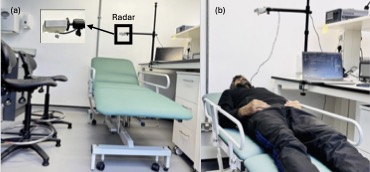
Every WiFi router is, in a sense, a tiny radar. As its signal travels across a room, it bounces off walls, furniture and people, and arrives at the receiver slightly changed by everything it touched along the way. Most of the time, that distortion is just noise to be filtered out. But to a sensing system designed to read it, that same distortion can carry the rhythm of someone breathing, the rise and fall of a chest, or the sudden disruption of a fall.
This is the premise behind contactless WiFi sensing for healthcare: using radio hardware that is already installed in nearly every home to monitor vital signs and movement, without asking anyone to wear a device. For people who find wearables uncomfortable, forget to charge them, or simply shouldn't need one to be looked after — older adults living independently, patients recovering at home, infants in a cot — that distinction matters.
The research reviews how far this idea has come: from detecting a single person's breathing rate in a quiet room, to the much harder problem of separating multiple people, filtering out pets and ambient movement, and making the system work reliably across different room layouts and hardware. It also sets out what's still missing before contactless sensing can be trusted in a clinical or care setting — chiefly, robustness across messy, real-world environments and clear evidence of accuracy against medical-grade monitoring.
The promise is a future where the infrastructure for ambient health monitoring is already sitting in your living room, doing nothing more unusual than serving your video calls — until it needs to flag that something has changed.
Based on
Contactless WiFi sensing and monitoring for future healthcare — emerging trends, challenges and opportunities (IEEE Reviews in Biomedical Engineering, 2022)
Top collaborators
- Y. Ge
- A. Taha
- K. Dashtipour